what is the progression of writing system from oldest to youngest
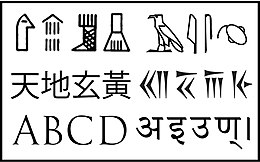 6 major historical writing systems (left to right, top to bottom: Sumerian pictographs, Egyptian hieroglyphs, Chinese syllabograms, Old Persian cuneiform, Roman alphabet, Southward Asian Devanagari) |
The history of writing traces the evolution of expressing linguistic communication by systems of markings.[1]
In the history of how writing systems have evolved in different human civilizations, more complete writing systems were preceded by proto-writing, systems of ideographic or early on mnemonic symbols (symbols or messages that brand remembering them easier). True writing, in which the content of a linguistic utterance is encoded so that another reader tin can reconstruct, with a fair caste of accuracy, the exact utterance written down, is a later development. It is distinguished from proto-writing, which typically avoids encoding grammatical words and affixes, making information technology more difficult or fifty-fifty impossible to reconstruct the exact significant intended by the author unless a groovy deal of context is already known in advance.
1 of the earliest known forms of written expression is cuneiform.[2]
Inventions of writing [edit]
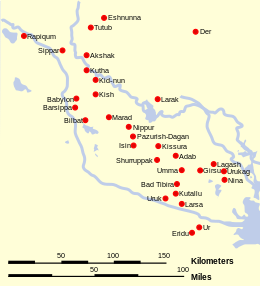
Writing was long thought to take been invented in a unmarried civilization, a theory named "monogenesis".[3] Scholars believed that all writing originated in ancient Sumer (in Mesopotamia) and spread over the earth from there via a process of cultural diffusion.[three] According to this theory, the concept of representing linguistic communication past written marks, though not necessarily the specifics of how such a system worked, was passed on past traders or merchants traveling betwixt geographical regions.[a] [4]
However, the discovery of the scripts of aboriginal Mesoamerica, far away from Middle Eastern sources, proved that writing had been invented more than one time. Scholars at present recognize that writing may have independently developed in at least four ancient civilizations: Mesopotamia (between 3400 and 3100 BCE), Arab republic of egypt (around 3250 BCE),[5] [6] [3] Prc (1200 BCE),[seven] and lowland areas of Southern United mexican states and Guatemala (by 500 BCE).[8]
Regarding ancient Egypt, several scholars[v] [9] [10] accept argued that "the earliest solid evidence of Egyptian writing differs in structure and style from the Mesopotamian and must therefore have developed independently. The possibility of 'stimulus diffusion' from Mesopotamia remains, but the influence cannot have gone beyond the transmission of an idea."[v] [11]
Regarding People's republic of china, it is believed that aboriginal Chinese characters are an independent invention because there is no prove of contact between aboriginal China and the literate civilizations of the Virtually East,[12] and because of the singled-out differences between the Mesopotamian and Chinese approaches to logography and phonetic representation.[13]
Contend surrounds the Indus script of the Bronze Age Indus Valley civilisation, the Rongorongo script of Easter Isle, and the Vinča symbols dated around 5500 BCE. All are undeciphered, and then information technology is unknown if they stand for authentic writing, proto-writing, or something else.
The Sumerian archaic (pre-cuneiform) writing and Egyptian hieroglyphs are generally considered the earliest truthful writing systems, both emerging out of their ancestral proto-literate symbol systems from 3400–3100 BCE, with earliest coherent texts from about 2600 BCE. The Proto-Elamite script is also dated to the same guess menses.[14]
Writing systems [edit]

Pre-cuneiform tags, with drawing of caprine animal or sheep and number (probably "ten"): "Ten goats", Al-Hasakah, 3300–3100 BCE, Uruk culture.[15]
Symbolic communication systems are distinguished from writing systems. With writing systems, i must normally understand something of the associated speech to comprehend the text. In contrast, symbolic systems, such as information signs, painting, maps, and mathematics, ofttimes do non crave prior noesis of a spoken language. Every homo community possesses language, a feature regarded by many as an innate and defining condition of humanity (run across Origin of language). Nevertheless the evolution of writing systems, and their fractional replacement of traditional oral systems of communication, take been sporadic, uneven, and slow. Once established, writing systems on the whole modify more slowly than their spoken counterparts and oft preserve features and expressions that no longer exist in the spoken linguistic communication.

There are considered to be three writing criteria for all writing systems. Firstly, writing must exist complete: it must have a purpose or some sort of significant to it, and a signal must be made or communicated in the text. Secondly, all writing systems must accept some sort of symbols which can be made on some sort of surface, whether physical or digital. Lastly, the symbols used in the writing system must mimic spoken word/voice communication, in society for communication to be possible.[16]
The greatest benefit of writing is that information technology provides the tool by which order can record information consistently and in greater detail, something that could not be accomplished as well previously by spoken give-and-take. Writing allows societies to transmit data and to share and preserve noesis.
Recorded history [edit]

The origins of writing appear during the offset of the pottery-phase of the Neolithic, when clay tokens were used to record specific amounts of livestock or commodities.[17] These tokens were initially impressed on the surface of round dirt envelopes then stored in them.[17] The tokens were then progressively replaced by flat tablets, on which signs were recorded with a stylus. Bodily writing is first recorded in Uruk, at the terminate of the 4th millennium BCE, and soon later in diverse parts of the Almost East.[17]
An ancient Mesopotamian poem gives the showtime known story of the invention of writing:
Because the messenger's mouth was heavy and he couldn't echo (the message), the Lord of Kulaba patted some dirt and put words on information technology, like a tablet. Until then, there had been no putting words on clay.
Scholars brand a reasonable distinction betwixt prehistory and history of early writing[20] just have disagreed concerning when prehistory becomes history and when proto-writing became "true writing". The definition is largely subjective.[21] Writing, in its most general terms, is a method of recording information and is composed of graphemes, which may, in plough, be composed of glyphs.[22]
The emergence of writing in a given area is usually followed by several centuries of fragmentary inscriptions. Historians mark the "historicity" of a culture by the presence of coherent texts in the civilization's writing system(s).[20]
Developmental stages [edit]


A conventional "proto-writing to true writing" organization follows a general series of developmental stages:
- Flick writing arrangement: glyphs (simplified pictures) direct represent objects and concepts. In connectedness with this, the following substages may be distinguished:
- Mnemonic: glyphs primarily every bit a reminder.
- Pictographic: glyphs straight represent an object or a concept such every bit (A) chronological, (B) notices, (C) communications, (D) totems, titles, and names, (E) religious, (F) community, (G) historical, and (H) biographical.
- Ideographic: graphemes are abstract symbols that direct stand for an idea or concept.
- Transitional system: graphemes refer non only to the object or idea that it represents but to its proper name likewise.
- Phonetic organisation: graphemes refer to sounds or spoken symbols, and the grade of the graphic symbol is not related to its meanings. This resolves itself into the following substages:
- Verbal: grapheme (logogram) represents a whole word.
- Syllabic: character represents a syllable.
- Alphabetic: grapheme represents an unproblematic audio.
The best known motion picture writing arrangement of ideographic or early mnemonic symbols are:
- Jiahu symbols, carved on tortoise shells in Jiahu, c. 6600 BCE
- Vinča symbols (Tărtăria tablets), c. 5300 BCE [25]
- Early Indus script, c. 3100 BCE
In the Old World, true writing systems developed from neolithic writing in the Early on Statuary Age (4th millennium BCE).
Literature and writing [edit]
The history of literature begins with the history of writing, simply literature and writing, though obviously connected, are non synonymous. The very first writings from ancient Sumer past whatsoever reasonable definition practice not constitute literature. The same is true of some of the early Egyptian hieroglyphics and the thousands of ancient Chinese government records. Scholars accept disagreed concerning when written record-keeping became more than like literature, but the oldest surviving literary texts date from a total millennium after the invention of writing. The earliest literary authors known by name are Ptahhotep (who wrote in Egyptian) and Enheduanna[26] (who wrote in Sumerian), dating to around the 24th and 23rd centuries BCE, respectively.
Locations and timeframes [edit]

Examples of the Jiahu symbols, markings found on tortoise shells, dated around 6000 BCE. Nigh of the signs were separately inscribed on dissimilar shells.[27]
Proto-writing [edit]
The first writing systems of the Early Bronze Historic period were not a sudden invention. Rather, they were a development based on before traditions of symbol systems that cannot be classified as proper writing, merely accept many of the characteristics of writing. These systems may be described as "proto-writing". They used ideographic or early mnemonic symbols to convey information, but it probably directly independent no tongue. These systems emerged in the early Neolithic period, as early equally the 7th millennium BCE, and include:
- The Jiahu symbols constitute carved in tortoise shells in 24 Neolithic graves excavated at Jiahu, Henan province, northern China, with radiocarbon dates from the 7th millennium BCE.[28] Most archaeologists consider these non directly linked to the earliest true writing.[29]
- Vinča symbols, sometimes chosen the "Danube script", are a gear up of symbols establish on Neolithic era (6th to 5th millennia BCE) artifacts from the Vinča culture of Cardinal Europe and Southeast Europe.[30]
- The Dispilio Tablet of the late 6th millennium may also be an example of proto-writing.
- The Indus script, which from 3500 BCE to 1900 BCE was used for extremely curt inscriptions.
Even later the Neolithic, several cultures went through an intermediate stage of proto-writing before they used proper writing. The quipu of the Incas (15th century CE), sometimes called "talking knots", may have been such a arrangement. Another example is the pictographs invented by Uyaquk before the development of the Yugtun syllabary for the Central Alaskan Yup'ik language in about 1900.
Bronze Age writing [edit]
Writing emerged in many dissimilar cultures in the Bronze Historic period. Examples are the cuneiform writing of the Sumerians, Egyptian hieroglyphs, Cretan hieroglyphs, Chinese logographs, Indus script, and the Olmec script of Mesoamerica. The Chinese script probable developed independently of the Centre Eastern scripts around 1600 BCE. The pre-Columbian Mesoamerican writing systems (including Olmec and Maya scripts) are also generally believed to have had independent origins. It is thought that the first true alphabetic writing was developed around 2000 BCE for Semitic workers in the Sinai by giving mostly Egyptian hieratic glyphs Semitic values (see History of the alphabet and Proto-Sinaitic alphabet). The Ge'ez writing system of Ethiopia is considered Semitic. It is likely to be of semi-contained origin, having roots in the Meroitic Sudanese ideogram system.[31] Most other alphabets in the world today either descended from this one innovation, many via the Phoenician alphabet, or were directly inspired by its pattern. In Italy, about 500 years passed from the early on Old Italic alphabet to Plautus (c. 750–250 BCE), and in the case of the Germanic peoples, the corresponding time span is again similar, from the first Elderberry Futhark inscriptions to early texts similar the Abrogans (c. 200–750 CE).
Cuneiform script [edit]
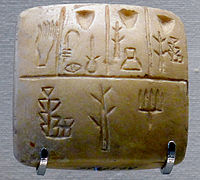
Tablet with proto-cuneiform pictographic characters (end of 4th millennium BCE), Uruk Three.
The original Sumerian writing system derives from a system of clay tokens used to represent commodities. Past the terminate of the 4th millennium BCE, this had evolved into a method of keeping accounts, using a round-shaped stylus impressed into soft clay at dissimilar angles for recording numbers. This was gradually augmented with pictographic writing by using a abrupt stylus to bespeak what was being counted. By the 29th century BCE, writing, at commencement only for logograms, using a wedge-shaped stylus (hence the term cuneiform) developed to include phonetic elements, gradually replacing round-stylus and sharp-stylus writing by effectually 2700–2500 BCE. Near 2600 BCE, cuneiform began to represent syllables of the Sumerian language. Finally, cuneiform writing became a general purpose writing system for logograms, syllables, and numbers. From the 26th century BCE, this script was adjusted to the Akkadian linguistic communication, and from at that place to others, such as Hurrian and Hittite. Scripts similar in appearance to this writing arrangement include those for Ugaritic and Quondam Persian.
Egyptian hieroglyphs [edit]
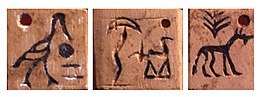
Designs on some of the labels or token from Abydos, carbon-dated to circa 3400–3200 BC and among the earliest form of writing in Arab republic of egypt.[32] [33] They are remarkably similar to contemporary clay tags from Uruk, Mesopotamia.[34]
Writing was very important in maintaining the Egyptian empire, and literacy was concentrated among an educated elite of scribes. Only people from sure backgrounds were immune to train equally scribes, in the service of temple, imperial (pharaonic), and military authorities.
Geoffrey Sampson stated that Egyptian hieroglyphs "came into beingness a little afterwards Sumerian script, and, probably [were], invented under the influence of the latter",[35] and that it is "likely that the general thought of expressing words of a language in writing was brought to Arab republic of egypt from Sumerian Mesopotamia".[36] [37] Despite the importance of early on Egypt–Mesopotamia relations, given the lack of directly evidence "no definitive determination has been fabricated every bit to the origin of hieroglyphics in aboriginal Arab republic of egypt".[38] Instead, it is pointed out and held that "the evidence for such direct influence remains flimsy" and that "a very credible argument can also exist made for the independent development of writing in Egypt".[39]
Since the 1990s, the discoveries of glyphs at Abydos, dated to between 3400 and 3200 BCE, may challenge the classical notion co-ordinate to which the Mesopotamian symbol system predates the Egyptian one, although Egyptian writing does make a sudden appearance at that time, while on the reverse Mesopotamia has an evolutionary history of sign usage in tokens dating dorsum to circa 8000 BCE.[33] These glyphs, establish in tomb U-J at Abydos are written on ivory and are probable labels for other goods found in the grave.[forty]
Elamite script [edit]
The undeciphered Proto-Elamite script emerges from equally early equally 3100 BCE. It is believed to have evolved into Linear Elamite by the after tertiary millennium and so replaced by Elamite Cuneiform adopted from Akkadian.
Indus script [edit]

Markings and symbols plant at diverse sites of the Indus Valley Civilisation have been labelled as the Indus script citing the possibility that they were used for transcribing the Harappan language.[41] Whether the script, which was in use from most 3500–1900 BCE, constitutes a Bronze Age writing script (logographic-syllabic) or proto-writing symbols is debated every bit it has not yet been deciphered. It is analyzed to have been written from right-to-left or in boustrophedon.[42]
Early Semitic alphabets [edit]
The kickoff "abjads", mapping single symbols to single phonemes merely not necessarily each phoneme to a symbol, emerged around 1800 BCE in Ancient Egypt, as a representation of language developed past Semitic workers in Arab republic of egypt, but by then alphabetic principles had a slight possibility of being inculcated into Egyptian hieroglyphs for upwards of a millennium.[ clarification needed ] These early abjads remained of marginal importance for several centuries, and it is just towards the end of the Bronze Age that the Proto-Sinaitic script splits into the Proto-Canaanite alphabet (c. 1400 BCE) Byblos syllabary and the South Arabian alphabet (c. 1200 BCE). The Proto-Canaanite was probably somehow influenced past the undeciphered Byblos syllabary and, in plow, inspired the Ugaritic alphabet (c. 1300 BCE).
Anatolian hieroglyphs [edit]
Anatolian hieroglyphs are an ethnic hieroglyphic script native to western Anatolia, used to tape the Hieroglyphic Luwian language. It first appeared on Luwian royal seals from the 14th century BCE.
Chinese writing [edit]
The primeval confirmed evidence of the Chinese script yet discovered is the torso of inscriptions on oracle bones and bronze from the tardily Shang dynasty. The earliest of these is dated to effectually 1200 BCE.[43] [44]
There have recently been discoveries of tortoise-shell carvings dating back to c. 6000 BCE, similar Jiahu Script, Banpo Script, but whether or not the carvings are complex enough to qualify as writing is under debate.[28] At Damaidi in the Ningxia Hui Autonomous Region, 3,172 cliff carvings dating to c. 6000–5000 BCE have been discovered, featuring 8,453 individual characters, such as the lord's day, moon, stars, gods, and scenes of hunting or grazing. These pictographs are reputed to be similar to the earliest characters confirmed to be written Chinese. If it is deemed to be a written language, writing in China will predate Mesopotamian cuneiform, long acknowledged as the first appearance of writing, by some ii,000 years; yet information technology is more likely that the inscriptions are rather a class of proto-writing, similar to the contemporary European Vinca script.
Cretan and Greek scripts [edit]
Cretan hieroglyphs are found on artifacts of Crete (early-to-mid-second millennium BCE, MM I to MM Iii, overlapping with Linear A from MM IIA at the earliest). Linear B, the writing system of the Mycenaean Greeks,[45] has been deciphered while Linear A has yet to be deciphered. The sequence and the geographical spread of the three overlapping, but singled-out, writing systems can be summarized as follows:[b] [45]
| Writing organisation | Geographical area | Time bridge |
|---|---|---|
| Cretan Hieroglyphic | Crete (eastward from the Knossos-Phaistos axis) | c. 2100−1700 BCE |
| Linear A | Crete (except extreme southwest), Aegean islands (Kea, Kythera, Melos, Thera), and Greek mainland (Laconia) | c. 1800−1450 BCE |
| Linear B | Crete (Knossos), and mainland (Pylos, Mycenae, Thebes, Tiryns) | c. 1450−1200 BCE |
Mesoamerica [edit]
A stone slab with 3,000-year-former writing, the Cascajal Block, was discovered in the Mexican state of Veracruz, and is an example of the oldest script in the Western Hemisphere, preceding the oldest Zapotec writing dated to almost 500 BCE.[46] [47] [48]
Of several pre-Columbian scripts in Mesoamerica, the one that appears to have been best developed, and has been fully deciphered, is the Maya script. The earliest inscriptions which are identifiably Maya date to the third century BCE, and writing was in continuous use until soon afterwards the arrival of the Castilian conquistadores in the 16th century CE. Maya writing used logograms complemented past a ready of syllabic glyphs: a combination somewhat similar to modern Japanese writing.
Atomic number 26 Age writing [edit]
The Phoenician alphabet is simply the Proto-Canaanite alphabet as information technology was continued into the Iron Historic period (conventionally taken from a cut-off date of 1050 BCE).[ citation needed ] This alphabet gave rise to the Aramaic and Greek alphabets. These in turn led to the writing systems used throughout regions ranging from Western Asia to Africa and Europe. For its part the Greek alphabet introduced for the beginning time explicit symbols for vowel sounds.[49] The Greek and Latin alphabets in the early centuries of the Mutual Era gave rise to several European scripts such equally the Runes and the Gothic and Cyrillic alphabets while the Aramaic alphabet evolved into the Hebrew, Arabic and Syriac abjads, of which the latter spread equally far as Mongolian script. The South Arabian alphabet gave ascension to the Ge'ez abugida. The Brahmic family unit of India is believed by some scholars to have derived from the Aramaic alphabet as well.[l]
Grakliani Hill writing [edit]
A previously unknown script was discovered[ when? ] in Georgia, over the Grakliani Hill just below a temple's collapsed altar to a fertility goddess from the seventh century BCE. These inscriptions differ from those at other temples at Grakliani, which show animals, people, or decorative elements.[51] The script bears no resemblance to any alphabet currently known, although its letters are conjectured to be related to aboriginal Greek and Aramaic.[51] The inscription appears to be the oldest native alphabet to be discovered in the whole Caucasus region,[52] In comparison, the earliest Armenian (8th century) and Georgian script date from the fifth century CE, merely later on the respective cultures converted to Christianity. By September 2015, an expanse of 31 by 3 inches of the inscription had been excavated.[51]
According to Vakhtang Licheli, head of the Plant of Archaeology of the State University, "The writings on the two altars of the temple are really well preserved. On the one altar several messages are carved in clay while the second altar's pedestal is wholly covered with writings."[53] The finding was made by unpaid students.[ citation needed ] In 2016 Grakliani Hill inscriptions were taken to Miami Laboratory for Beta analytic radiocarbon dating which shocked the world;[ citation needed ] Inscriptions are fabricated in 1005–950 BCE. According to Licheli, who headed the archaeological expedition, the collective findings assert the 3000-year-sometime existence of a Georgian statehood.[54]
Writing in the Greco-Roman civilizations [edit]

Greek scripts [edit]
The history of the Greek alphabet began in at least the early on eighth century BCE when the Greeks adapted the Phoenician alphabet for use with their own language.[55] The letters of the Greek alphabet are more or less the same equally those of the Phoenician alphabet, and in modernistic times both alphabets are arranged in the aforementioned society.[55] The adapter(s) of the Phoenician organisation added iii letters to the end of the serial, called the "supplementals". Several varieties of the Greek alphabet developed. One, known as Western Greek or Chalcidian, was used west of Athens and in southern Italia. The other variation, known as Eastern Greek, was used in nowadays-mean solar day Turkey and by the Athenians, and eventually the residue of the world that spoke Greek adopted this variation. Subsequently kickoff writing right to left, like the Phoenicians, the Greeks eventually chose to write from left to right. Occasionally however, the author would showtime the next line where the previous line finished, so that the lines would read alternately left to right, then right to left, and and then on. This was known every bit "boustrophedon" writing, which imitated the path of an ox-drawn plough, and was used until the sixth century.[56]
Italic scripts and Latin [edit]

Greek is in plow the source for all the modern scripts of Europe. The most widespread descendant of Greek is the Latin script, named for the Latins, a central Italian people who came to boss Europe with the rising of Rome. The Romans learned writing in about the 5th century BCE from the Etruscan civilization, who used one of a number of Italic scripts derived from the western Greeks. Due to the cultural authorisation of the Roman land, the other Old Italic scripts take not survived in whatever great quantity, and the Etruscan language is more often than not lost.
Writing during the Middle Ages [edit]
With the collapse of the Roman potency in Western Europe, literary evolution became largely confined to the Eastern Roman Empire and the Farsi Empire. Latin, never ane of the primary literary languages, quickly declined in importance (except inside the Roman Catholic Church). The primary literary languages were Greek and Western farsi, though other languages such as Syriac and Coptic were important too.
The rise of Islam in the 7th century led to the rapid rise of Arabic as a major literary language in the region. Arabic and Persian quickly began to overshadow Greek's role as a linguistic communication of scholarship. Arabic script was adopted every bit the chief script of the Persian language and the Turkish language. This script also heavily influenced the development of the cursive scripts of Greek, the Slavic languages, Latin, and other languages.[ citation needed ] The Standard arabic language also served to spread the Hindu–Standard arabic numeral system throughout Europe.[ citation needed ] By the beginning of the second millennium, the city of Córdoba in modern Spain had go 1 of the foremost intellectual centers of the earth and independent the world's largest library at the fourth dimension.[57] Its position as a crossroads between the Islamic and Western Christian worlds helped fuel intellectual evolution and written advice between both cultures.
Renaissance and the modernistic era [edit]
By the 14th century a rebirth, or renaissance, had emerged in Western Europe, leading to a temporary revival of the importance of Greek, and a deadening revival of Latin as a meaning literary linguistic communication. A similar though smaller emergence occurred in Eastern Europe, especially in Russian federation. At the same time Arabic and Persian began a slow decline in importance as the Islamic Golden Age ended. The revival of literary evolution in Western Europe led to many innovations in the Latin alphabet and the diversification of the alphabet to codify the phonologies of the various languages.
The nature of writing has been constantly evolving, particularly due to the development of new technologies over the centuries. The pen, the press printing, the computer and the mobile phone are all technological developments which have contradistinct what is written, and the medium through which the written give-and-take is produced. Especially with the advent of digital technologies, namely the computer and the mobile phone, characters can be formed past the press of a button, rather than making a physical motion with the hand.
Writing materials [edit]
There is no very definite statement as to the fabric which was in most common use for the purposes of writing at the first of the early writing systems.[58] In all ages it has been customary to engrave on stone or metal, or other durable cloth, with the view of securing the permanency of the tape. Metals, such equally stamped coins, are mentioned every bit a material of writing; they include atomic number 82,[c] brass, and gold. There are also references to the engraving of gems, such equally with seals or signets.[58]
The common materials of writing were the tablet and the roll, the former probably having a Chaldean origin, the latter an Egyptian. The tablets of the Chaldeans are small-scale pieces of clay, somewhat crudely shaped into a form resembling a pillow, and thickly inscribed with cuneiform characters.[d] Similar use has been seen in hollow cylinders, or prisms of six or eight sides, formed of fine terra cotta, sometimes glazed, on which the characters were traced with a small stylus, in some specimens and then minutely as to require the aid of a magnifying-drinking glass.[58]
In Egypt the main writing material was of quite a different sort. Wooden tablets are found pictured on the monuments; but the material which was in common utilise, even from very ancient times, was the papyrus, having recorded use every bit far back as 3,000 BCE.[59] This reed, found chiefly in Lower Egypt, had various economic means for writing. The pith was taken out and divided by a pointed musical instrument into the thin pieces of which it is composed; it was then flattened by pressure, and the strips glued together, other strips existence placed at correct angles to them, so that a roll of any length might be manufactured. Writing seems to have become more than widespread with the invention of papyrus in Egypt. That this material was in apply in Egypt from a very early period is evidenced by still existing papyrus of the primeval Theban dynasties.[sixty] Equally the papyrus, being in great demand, and exported to all parts of the world, became very plush, other materials were ofttimes used instead of it, among which is mentioned leather, a few leather mills of an early period having been found in the tombs.[58] Parchment, using sheepskins left later on the wool was removed for fabric, was sometimes cheaper than papyrus, which had to be imported outside Arab republic of egypt. With the invention of woods-pulp paper, the toll of writing material began a steady pass up. Forest-lurid paper is still used today, and in contempo times efforts have been made in order to improve bond strength of fibers. Two main areas of test in this regard take been "dry strength of paper" and "wet spider web strength".[61] The onetime involves examination of the physical backdrop of the paper itself, while the latter involves using additives to improve strength.
See also [edit]
Archaeology and history
- Acheulean
- Aurignacian
- Ethnoarchaeology
- Gradeshnitsa tablets
- History of numbers
- History of art
- History of developmental dyslexia
- Hoabinhian
- Gravettian
- Oldowan
- Palaeography
- Protoscholastic writing
Other
- Asemic writing
- Bastarda
- Blackletter
- Volume manus
- Braille
- Calligraphy
- Chancery manus
- Court hand
- Cursive
- Paw (writing style)
- Handwriting
- Italic script
- Kana § History
- Law manus
- List of writing systems
- Manuscript
- Ogham
- Penmanship
- Ronde script (calligraphy)
- Rotunda (script)
- Round hand
- Secretary paw
- Shorthand
- Uncials
Notes [edit]
- ^ More than recent examples of this include Pahawh Hmong and the Cherokee syllabary.
- ^ Note that the beginning date refers to outset attestations, the assumed origins of all scripts lie further dorsum in the past.
- ^ Although whether to writing on pb, or filling up the hollow of the letters with lead, is not sure.
- ^ These documents have been in general enveloped, after they were baked, in a cover of moist clay, upon which their contents have been again inscribed, so as to present externally a duplicate of the writing within; and the tablet in its cover has then been baked afresh. The aforementioned fabric was largely used by the Assyrians, and many of their clay tablets still remain. They are of diverse sizes, ranging from nine inches long by six and a half wide, to an inch and a one-half by an inch wide, and even less. Some thousands of these have been recovered; many are historical, some linguistic, some geographical, some astronomical.
References [edit]
Citations [edit]
- ^ Peter T. Daniels, "The Study of Writing Systems", in The World'south Writing Systems, ed. Bright and Daniels, p.3
- ^ Empires of the Plain: Henry Rawlinson and the Lost Languages of Babylon, New York, St. Martin'southward Press (2003) ISBN 0-312-33002-2
- ^ a b c Olson, David R.; Torrance, Nancy (16 February 2009). The Cambridge Handbook of Literacy. Cambridge University Press. ISBN9780521862202.
- ^ Daniels, Peter T. "The First Civilizations". In Daniels, Peter T.; Bright, William (eds.). The World's Writing Systems. p. 24.
- ^ a b c Regulski, Ilona (ii May 2016). "The Origins and Early Development of Writing in Arab republic of egypt". Oxford Handbooks Online. doi:10.1093/oxfordhb/9780199935413.013.61.
- ^ Wengrow, David (2011). "The Invention of Writing in Arab republic of egypt". In Teeter, Emily (ed.). Before the Pyramids: Origin of Egyptian Civilization. Oriental Institute, Academy of Chicago. pp. 99–103.
- ^ Boltz, William (1994). The origin and early on development of the Chinese writing organisation. American Oriental Gild. p. 31.
- ^ Fagan, Brian M.; Beck, Charlotte; Michaels, George; Scarre, Chris; Silberman, Neil Asher, eds. (1996). "Writing: Introduction". The Oxford Companion to Archaeology. Oxford University Press. p. 762. doi:ten.1093/acref/9780195076189.001.0001. ISBN978-0-19-507618-nine.
- ^ Baines, John (9 December 2004). "The earliest Egyptian writing: Evolution, context, purpose". In Boudreau, Vincent (ed.). The Start Writing: Script Invention every bit History and Process. Cambridge, United kingdom: Cambridge University Press. pp. 150–189. ISBN978-0-521-83861-0.
- ^ Dreyer, G. (1998). Umm el-Qaab I. Das prädynastische Königsgrab U-j und seine frühen Schriftzeugnisse (in German). Mainz, Deutschland: Philip von Zabern.
- ^ Forest, Christopher (2010). "Visible language: the earliest writing systems". Visible Linguistic communication: Inventions of Writing in the Ancient Middle East and Beyond. Chicago: The Oriental Institute of the University of Chicago. pp. 15–25.
- ^ David N. Keightley, Noel Barnard. The Origins of Chinese culture Folio 415-416
- ^ Leick, Gwendolyn (1994). Sex and eroticism in Mesopotamian literature. London: Routledge. p. 3. ISBN9780203462751.
- ^ Walker, .C. (1989). Reading The By Cuneiform. British Museum. pp. 7-9.
- ^ "Image gallery: tablet / bandage". British Museum.
- ^ Fischer, Steven R. (March 2018). A history of reading. ISBN9781789140682. OCLC 1101969075.
- ^ a b c "Beginning in the pottery-phase of the Neolithic, dirt tokens are widely attested as a organization of counting and identifying specific amounts of specified livestock or bolt. The tokens, enclosed in clay envelopes after being impressed on their rounded surface, were gradually replaced by impressions on flat or plano-convex tablets, and these in turn past more or less conventionalized pictures of the tokens incised on the clay with a reed stylus. That final step completed the transition to total writing, and with it the consistent power to record contemporary events for posterity".W. Hallo; W. Simpson (1971). The Ancient About Due east. New York: Harcourt, Brace, Jovanovich. p. 25.
- ^ Daniels, Peter T. (1996). The World'southward Writing Systems. Oxford University Press. p. 45. ISBN9780195079937.
- ^ a b Boudreau, Vincent (2004). The First Writing: Script Invention every bit History and Process. Cambridge University Press. p. 71. ISBN9780521838610.
- ^ a b Shotwell, James Thomson. An Introduction to the History of History. Records of civilization, sources and studies. New York: Columbia Academy Printing, 1922.
- ^ Smail, Daniel Lord. On Deep History and the Brain. An Ahmanson foundation volume in the humanities. Berkeley: Academy of California Press, 2008.
- ^ Bricker, Victoria Reifler, and Patricia A. Andrews. Epigraphy. Supplement to the Handbook of Center American Indians, five. 5. Austin: University of Texas Press, 1992.
- ^ Barraclough, Geoffrey; Stone, Norman (1989). The Times Atlas of World History . Hammond Incorporated. p. 53. ISBN9780723003045.
- ^ Senner, Wayne M. (1991). The Origins of Writing. Academy of Nebraska Press. p. 77. ISBN9780803291676.
- ^ Haarmann, Harald: "Geschichte der Schrift", C.H. Beck, 2002, ISBN iii-406-47998-7, p. 20
- ^ Salami, Minna (2020). "Chapter 2: Of Liberation". Sensuous Knowledge: A Black Feminist Approach For Everyone. Amistad. ISBN9780062877062.
- ^ Helen R. Pilcher 'Earliest handwriting found? Chinese relics hint at Neolithic rituals', Nature (30 April 2003), doi:ten.1038/news030428-7 "Symbols carved into tortoise shells more than viii,000 years ago ... unearthed at a mass-burial site at Jiahu in the Henan Province of western China". Li, Ten., Harbottle, G., Zhang, J. & Wang, C. 'The earliest writing? Sign employ in the 7th millennium BCE at Jiahu, Henan Province, China'. Antiquity, 77, 31 - 44, (2003).
- ^ a b "Archaeologists Rewrite History". Red china Daily. 12 June 2003.
- ^ Houston, Stephen D. (2004). The First Writing: Script Invention as History and Process. Cambridge University Press. pp. 245–half dozen. ISBN978-0-521-83861-0.
- ^ Haarmann 2010, 10: 5300–3200 BC.
- ^ "Meroitic Writing System". Library.cornell.edu. four April 2004. Retrieved 31 January 2010.
- ^ Scarre, Chris; Fagan, Brian M. (2016). Ancient Civilizations. Routledge. p. 106. ISBN9781317296089.
- ^ a b "The seal impressions, from various tombs, date fifty-fifty further dorsum, to 3400 BCE. These dates claiming the normally held belief that early on logographs, pictographic symbols representing a specific place, object, or quantity, offset evolved into more complex phonetic symbols in Mesopotamia." Mitchell, Larkin. "Primeval Egyptian Glyphs". Archeology. Archaeological Institute of America. Retrieved 29 February 2012.
- ^ Conference, William Foxwell Albright Centennial (1996). The Written report of the Ancient Nearly East in the Xx-first Century: The William Foxwell Albright Centennial Briefing. Eisenbrauns. pp. 24–25. ISBN9780931464966.
- ^ Geoffrey Sampson (ane Jan 1990). Writing Systems: A Linguistic Introduction. Stanford Academy Press. pp. 78–. ISBN978-0-8047-1756-4 . Retrieved 31 October 2011.
- ^ Geoffrey W. Bromiley (June 1995). The international standard Bible encyclopedia. Wm. B. Eerdmans Publishing. pp. 1150–. ISBN978-0-8028-3784-4 . Retrieved 31 Oct 2011.
- ^ Iorwerth Eiddon Stephen Edwards, et al., The Cambridge Ancient History (3d ed. 1970) pp. 43–44.
- ^ Robert E. Krebs; Carolyn A. Krebs (December 2003). Groundbreaking scientific experiments, inventions, and discoveries of the aboriginal world. Greenwood Publishing Group. pp. 91ff. ISBN978-0-313-31342-4 . Retrieved 31 October 2011.
- ^ Simson Najovits, Egypt, Trunk of the Tree: A Modern Survey of an Aboriginal Land, Algora, 2004, pp. 55–56.
- ^ Baines, J. (2007). Visual and Written Culture in Ancient Egypt . Oxford. pp. 118. ISBN978-0-19-815250-7.
- ^ "Indus Script". World History Encyclopedia.
- ^ "Harappan Sscript". Swell Russian Encyclopedia.
- ^ Robert Bagley (2004). "Anyang writing and the origin of the Chinese writing system". In Houston, Stephen (ed.). The Beginning Writing: Script Invention as History and Procedure. Cambridge Academy Press. p. 190. ISBN9780521838610 . Retrieved 3 Apr 2019.
- ^ William G. Boltz (1999). "Language and Writing". In Loewe, Michael; Shaughnessy, Edward 50. (eds.). The Cambridge History of Ancient China: From the Origins of Civilization to 221 BC. Cambridge University Printing. p. 108. ISBN9780521470308 . Retrieved 3 April 2019.
- ^ a b Olivier 1986, pp. 377f.
- ^ "Writing May Be Oldest in Western Hemisphere". The New York Times. xv September 2006. Retrieved 30 March 2008.
A stone slab bearing 3,000-twelvemonth-old writing previously unknown to scholars has been establish in the Mexican state of Veracruz, and archaeologists say it is an example of the oldest script e'er discovered in the Western Hemisphere.
- ^ "'Oldest' New World writing found". BBC. 14 September 2006. Retrieved xxx March 2008.
Ancient civilisations in United mexican states developed a writing system as early every bit 900 BC, new evidence suggests.
- ^ "Oldest Writing in the New World". Science . Retrieved thirty March 2008.
A block with a hitherto unknown system of writing has been found in the Olmec heartland of Veracruz, United mexican states. Stylistic and other dating of the block places it in the early on starting time millennium before the mutual era, the oldest writing in the New World, with features that firmly assign this pivotal development to the Olmec civilization of Mesoamerica.
- ^ Millard 1986, p. 396
- ^ Salomon, Richard (1996). "Brahmi and Kharoshthi". The World's Writing Systems. Oxford Academy Printing. ISBN978-0-19-507993-7.
- ^ a b c "Ancient Script Spurs Rethinking of Celebrated 'Backwater'". History. 16 September 2015.
- ^ "Archaeologists Thrilled past Historic Script Discovery in Georgia". Georgia Today on the Spider web.
- ^ "Aboriginal Georgian site granted cultural heritage status". Agenda.ge.
- ^ "Discoveries at Grakliani Hill Volition Change History".
- ^ a b McCarter, P. Kyle. "The Early Diffusion of the Alphabet", The Biblical Archaeologist 37, No. 3 (September 1974): 54–68. page 62.
- ^ Lyons, Martyn (2011). Books: a Living History. Los Angeles, California: Getty Publications. p. 24. ISBN9781606060834.
- ^ Bury, J. B. The Cambridge Medieval History volumes 1-5. p. 1215.
- ^ a b c d McClintock, J., & Strong, J. (1885). Cyclopedia of Biblical, theological, and ecclesiastical literature: Supplement. New York: Harper. Pages 990–997.
- ^ Gascolgne, Arthur Bamber. "HISTORY OF WRITING MATERIALS". Retrieved 18 February 2019.
- ^ Marker, Joshua J. "Egyptian Papyrus". Globe History Encyclopedia.
- ^ Lindström, Tom (Summer 2005). "On the nature of articulation strength in newspaper-A review of dry and wet strength resins used in newspaper manufacturing". 13th Primal Research Symposium. ane: 457–562 – via Researchgate.
Sources [edit]
- Millard, A. R. (1986). "The Infancy of the Alphabet". World Archæology. 17 (iii): 390–398. doi:10.1080/00438243.1986.9979978.
- Olivier, J.-P. (1986). "Cretan Writing in the Second Millennium B.C". World Archeology. 17 (3): 377–389. doi:10.1080/00438243.1986.9979977.
- Norman, Jerry (1988). Chinese. Cambridge University Printing. ISBN0-521-29653-six.
- Lambert, J.50.F. (2014-2017). Termcraft: The emergence of terminology science from the Vinčans and Sumerians to Aristotle. Lulu Printing. ISBN 978-i-7751129-two-1.
Further reading [edit]
- 21st century sources
- The Idea of Writing: Writing Across Borders. Edited past Alex de Voogt, Joachim Friedrich Quack. BRILL, 9 Dec 2011.
- Powell, Barry B. 2009. Writing: Theory and History of the Technology of Civilisation, Oxford: Blackwell. ISBN 978-i-4051-6256-2
- Steven R. Fischer A History of Writing, Reaktion Books 2005 CN136481
- Hoffman, Joel 1000. 2004. In the Beginning: A Short History of the Hebrew Linguistic communication. New York University Press. Chapter three.
- Jean-Jacques Glassner. The Invention of Cuneiform: Writing in Sumer. JHU Printing, 2003. ISBN 0801873894
- Late 20th century sources
- Andrew Robinson, The Story of Writing. Thames & Hudson 1995 (second edition: 1999). ISBN 0-500-28156-4
- Hans J. Nissen, P. Damerow, R. Englund, Primitive Bookkeeping, Academy of Chicago Press, 1993, ISBN 0-500-01665-viii
- Denise Schmandt-Besserat, Before Writing, Vol. I: From Counting to Cuneiform. Academy of Texas Press, 1992. ISBN 0292707835
- Denise Schmandt-Besserat, HomePage, How Writing Came About, University of Texas Press, 1992, ISBN 0-292-77704-3.
- Saggs, H., 1991. Civilization Earlier Greece and Rome. Yale University Press. Affiliate four.
- Jack Goody, The Logic of Writing and the Organization of Society. Cambridge University Press, 1986
- Earlier 20th century sources
- David Diringer Writing. New York: Praeger. 1962.
- Otto Neugebauer, Abraham Joseph Sachs, Albrecht Götze. Mathematical Cuneiform Texts. Pub. jointly by the American Oriental Club and the American Schools of Oriental Research, 1945.
- Smith, William Anton. The Reading Process. New York: The Macmillan company, 1922.
- Chisholm, Hugh. Encyclopædia Britannica. A Dictionary of Arts, Sciences, Literature and General Information. Cambridge, Eng: University Press, 1911. "Writing".
- Clodd, Edward. The Story of the Alphabet. Library of useful stories.
External links [edit]
- Cuneiform
- cdli:wiki: Assyriological tools for specialists in cuneiform studies
- General
- History of Writing. historian.net
- The World'due south Writing Systems, all 294 known writing systems, each with a typographic reference glyph and Unicode status
- Denise Schmandt-Besserat HomePage
- Children of the Code: A Brief History of Writing – Online Video
- Broadcasts
- Corking the Maya Code. NOVA, Public Broadcasting Service. (Timeline (flash))
- BBC on tortoise shells discovered in China
- Fragments of pottery discovered in modern Islamic republic of pakistan
- Egyptian hieroglyphs c. 3000 BC
reynoldsherad1938.blogspot.com
Source: https://en.wikipedia.org/wiki/History_of_writing
0 Response to "what is the progression of writing system from oldest to youngest"
Postar um comentário